Long Term Care Insurance
From the desk of Robert Simpton, Certified Financial Planner
About 49 percent of men and 64 percent of women reaching age 65 today will need significant long-term care during their remaining years, according to a 2022 study from the federal Department of Health and Human Services.
ANNUAL MEDIAN COSTS OF LONG-TERM CARE
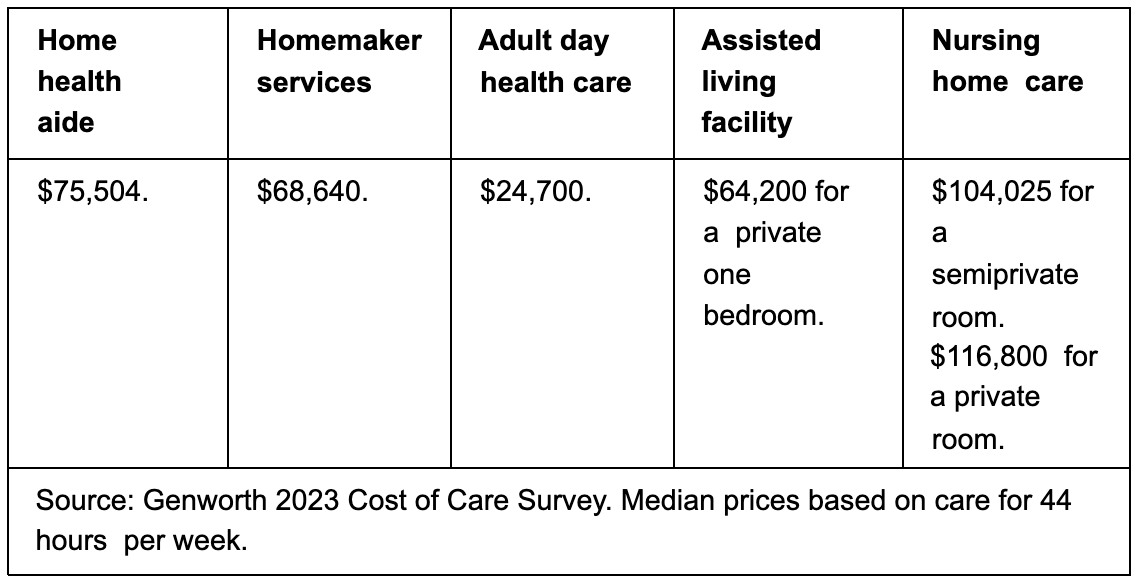
Long term Care insurance (LTC) is needed most to protect your wealth after you retire and as you age. Life insurance protects the future income of an individual in case that individual meets with a premature deadly accident or illness. It is meant to replace the future earnings of that person so that loved ones left behind can enjoy the same lifestyle as before. The house payments, education costs, and retirement savings that the decedent would have been able to provide before the tragedy. It is usually not needed after retirement because the house may be paid for, the retirement savings are already there for the future, and the kids are off the payroll. You have heard us state many times that most are over-insured. As we age and save, the need for life insurance declines.
After retirement, you will want to protect those savings from being exhausted due to the possible need for a long-term care plan. Long term care facilities cost multiple thousands of dollars a month and any extended stay could exhaust your savings. After your savings are gone, your only alternative is to go on Medicaid after you no longer have any assets. Medicaid is paid for by the state and offers very basic benefits. LTC insurance is meant to pay for the expensive long term care needs while protecting your savings.
We recommend LTC after retirement so that, like your car or homeowner’s insurance, it can pay the expensive costs of long-term care needs. It is especially effective when one person in a committed couple needs long-term care that could decimate the assets of the family and leave the remaining spouse destitute. If planned well, both partners will have the peace of mind of knowing that, should one get sick and not be able to function normally, that the strains and costs of caring for that affected individual will not exhaust the remaining spouse’s energy, time and assets. Many options are available for LTC. Some policies offer only the LTC benefits, while others may have a life insurance component attached to them. If the LTC is not needed, the life insurance will compensate for all of the premiums paid. The cost of LTC is generally repaid within the first two years of a care facility.
As stated above, not all LTC policies are the same in shape or form. What is the biggest downfall to having this type of policy? The cost. What if you never use it? That money just goes away with traditional LTC policies. What if there was an alternative?
In these cases, we recommended a certain type of policy that is paid for 100% up front or over a course of just a few years. For example, the client deposited $75,000. From day one, the client now had $375,000 in LTC benefits should it be needed. That breaks down to receiving nearly $5,000 a month for at least 6 years. If the client never needed the funds, which is great, then the heirs receive a check after the death of the client in the amount of nearly $175,000. That money wasn’t wasted! It comes back to the heirs in a check. What happens should the client change their mind and say “You know what? I want that money back.”? In this scenario, the client could cancel the policy and receive a check for most of what they paid in.
$75,000 One Time Paid Premium
Long Term Care Benefits
$375,000
$4800 month 6 years
Death Benefit
$174,000
Surrender Value
$60,000
There are many options to choose from when shopping for a policy like inflation protection, length of stay, or amount of benefit that dictates the cost as well as the health of the individual. Many companies provide a grid of options that can help you pick out the premium that you can afford and the amount of benefit or length of stay that you would anticipate. We really urge clients to begin looking at this form of insurance while they are in their 50’s because they may have optimal health, and the premiums are generally lower.
Remember, LTC Insurance is not required, however, it can have a massive influence on your overall financial health. Medicare does not pay for long term care, and should you use Medicaid you do not have much choice in the facility that you can afford. Being prepared with the right kind of insurance for you can give you the option of where you are accommodated and the amenities that may be offered. Therefore, we urge clients to consider LTC insurance in their financial plans that can provide peace of mind at a time when they are most vulnerable.