The Financial Genome: What DNA Can Teach Us About Wealth

We often think of personal finance through the lens of engineering—building a budget, balancing a spreadsheet, or constructing a portfolio. But human behavior and economic markets are rarely that rigid. Instead, personal finance behaves much more like a living organism: it is adaptive, prone to sudden environmental shifts, and relies on foundational structures to survive.
If you want to build a truly resilient financial life, the ultimate blueprint isn't found in a textbook; it’s found inside your own cells. Here is what biological DNA can teach us about managing our money.
1. The Core Blueprint: Your Financial "Base Pairs"
At its core, DNA relies on just four chemical bases (A, T, C, and G) paired together in endless combinations to build every complex organism on Earth.
In financial planning, you don't need a thousand complex products to succeed. A resilient financial life is built on four fundamental "base pairs" that must link together seamlessly:
Income & Expenses: Your budget
Assets & Liabilities: Your balance sheet
Risk & Reward: The trade-off between keeping money safe and letting it grow.
Protection & Growth: Insurance (protecting what you have) and investing (building what you need).
Just as a mutation in DNA base pairs can alter an organism’s traits, breaking the bond between these financial fundamentals—like taking massive risks without protection—can destabilize your entire system.
2. The Central Dogma: From Intention to Reality
DNA doesn’t just sit passively in the cell; it follows a strict operational pipeline called the Central Dogma to turn static instructions into physical reality:
DNA (The Blueprint) RNA (The Messenger) Protein (The Action)
Most people get stuck at the "DNA" stage of finance. They never create a true blueprint. What they do create is ideas. Blueprints (Financial Plans) take the idea and make it a plan.
To make your financial goals reality, you have to establish your own molecular assembly line:
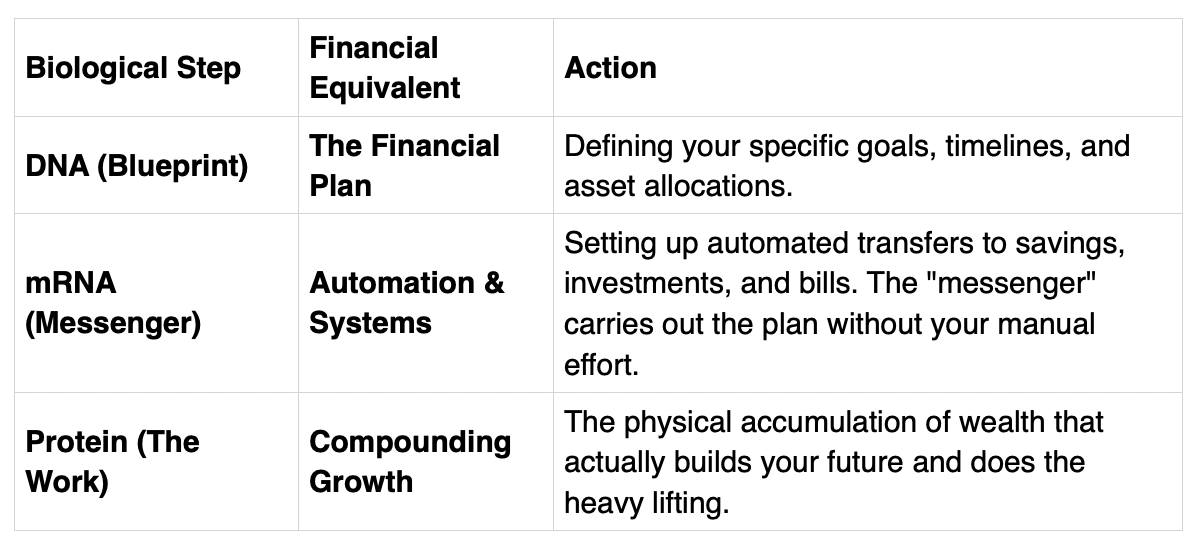
Without automation and daily habits (the mRNA), your financial plan remains a static, useless blueprint locked away in a drawer.
3. Epigenetics: Adapting to Your Environment
You are not entirely trapped by your genetics. Through a field called epigenetics, your body can turn specific genes "on" or "off" based on your environment, stress levels, and diet. The blueprint stays the same, but the expression changes to help you survive.
Your financial plan needs the exact same evolutionary flexibility. This is the primary function of the Financial Planner. To check and make sure that you are still ion track no matter what happens in the economic cycle. A rigid financial plan breaks the moment life happens.
Economic Volatility: When inflation spikes or markets dip, you need to turn "on" your defensive financial genes—cutting discretionary spending and leaning on cash reserves.
Life Changes: Getting married, having a child, or changing careers requires your financial expression to adapt, shifting from aggressive growth to wealth preservation, or vice versa.
A good financial plan isn't written in stone; it is a living, breathing document that adapts to the climate around it.
4. Genetic Diversity: The Power of Diversification
If a population of organisms is genetically identical, a single disease can wipe out the entire species. Nature relies on genetic diversity to ensure that even if the environment changes drastically, some individuals will possess the traits necessary to survive.
In finance, this is the golden rule of diversification.
Investing all your money into a single stock, cryptocurrency, or real estate market is the financial equivalent of a monoculture.
By spreading your capital across different asset classes (stocks, bonds, real estate, international markets), you ensure that when one sector faces an "extinction event," (read bear market) the rest of your financial genome keeps you alive and moving forward.
The Bottom Line
Your DNA has evolved over billions of years to be the most efficient, resilient, and adaptive software on the planet. By treating your financial planning less like a rigid math problem and more like a living biological system—built on solid fundamentals, automated for execution, diversified for safety, and adaptable to change—you ensure your wealth doesn’t just survive, but thrives.
Redfish Capital Management, LLC is registered as an investment adviser with the SEC and only transacts business in states where it is properly registered or is excluded or exempted from registration requirements. Registration as an investment adviser does not constitute an endorsement of the firm by the SEC, nor does it indicate that the adviser has attained a particular level of skill or ability.
The content presented is developed from sources believed to be accurate and should not be regarded as a complete analysis of the subjects discussed. All expressions of opinion reflect the judgment of the author and are subject to change. The information in this material is not intended as tax or legal advice. A legal or tax professional should be consulted for specific information regarding your individual situation.
The material presented is for general informational purposes only and does not constitute the rendering of personalized investment advice. Past performance may not be indicative of future results. All investment strategies have the potential for profit or loss. Different types of investments involve varying degrees of risk, and there can be no assurance that any specific investment or strategy will be suitable or profitable for a client's portfolio. Content should not be construed as an offer to buy or sell, or a solicitation of any offer to buy or sell any of the securities mentioned.