Is there such thing as TOO much money?

Is there such a thing as TOO much money?
One would think not. In fact, I don't guess that this question has ever crossed your mind. Maybe the question would be better phrased like this: Is there such a thing as having TOO much money in my retirement accounts? This question can be easily answered. The answer is yes. There is a silent tax trap that awaits.
Just this summer alone we at Redfish Capital have addressed three different high net worth client households where this is the case, and we have created three unique plans for each household to remedy this situation.
Many of you must be thinking I am nuts but hear me out. At the end of the day, the whole investing and financial planning goal is to have money that pays you in the form of income that lasts for your entire lifetime. So, it is not about how much money you have squirreled away as much as it is about how that money is paid to you and how it is taxed. Income tax rates are higher than the long-term capital gains rate. Tax-free investments are obviously better than taxable investments. Duh.
Example:
For most of our lives we have been told and advised that jamming as much money as we can into our retirement accounts is the best way to go. I get that logic, and it does make sense for most people...not all. This method has two-pronged benefits. First was that the money that was deferred from the paycheck and deposited into a 401K, 403B, SEP, or IRA received an advantage as the amount deferred into the account was not counted as taxable income. Great. The second benefit was that this money was not taxed annually as it grew. The tax would be due when we took the money out of the account to spend it. Whatever comes out gets taxed at our income tax rate.
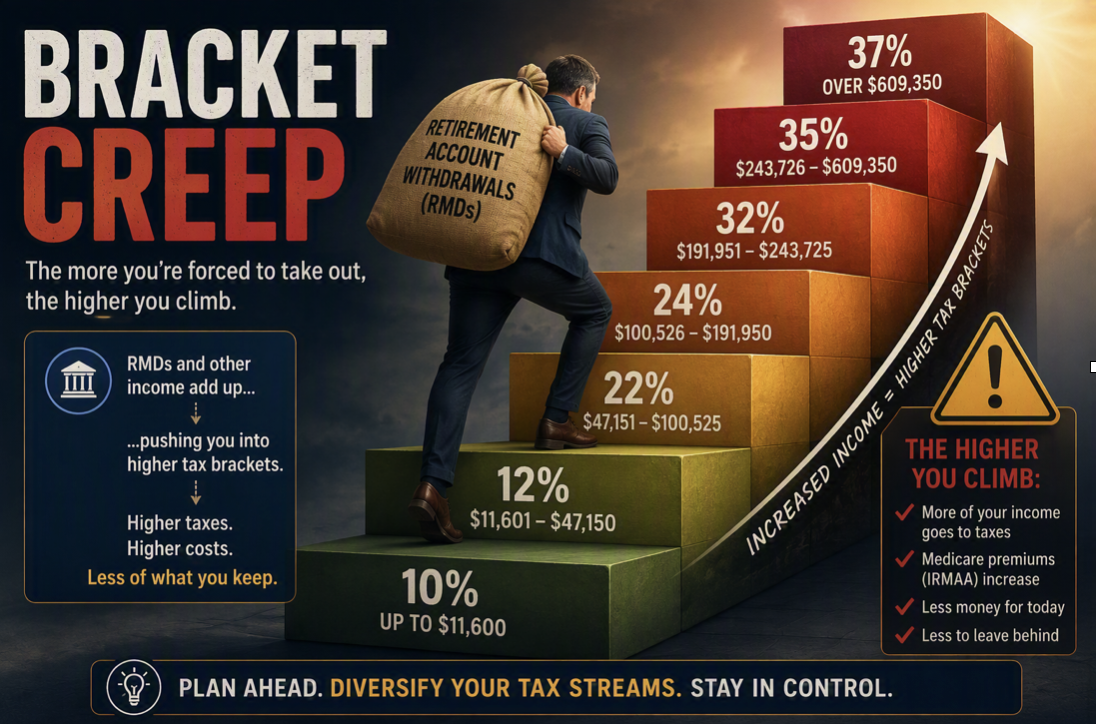
What can happen for some is that when we hit the retirement years and we take funds out of the retirement account, we can enter into what we refer to as tax bracket creep. When calculating our annual taxes, accountants look at all of the income sources, add them up, and the federal tax brackets tell us what amount of tax is due based on a percentage.
Some retirement accounts can grow into millions of dollars. When this happens, and we reach the age of RMD or Required Minimum Distributions (age 73 or 75 depending on when you were born) we are forced to take money out of the retirement account based off a figure produced by the IRS that figures your lifetime expectancy and how much money you would need to withdraw annually to bring that account down to zero. When the numbers get large, so do the RMD's. We have seen some people accumulate over $10 million in their retirement accounts. These RMD's are much more than they could spend in each given year, but they must take them out. This amount forces the tax bracket higher thus what we mentioned as tax bracket creep. In addition to this problem, Income Related Monthly Adjustment Amount or IRMAA can drastically spike Medicare Part B and D premiums. The only way this could have been solved would be if they had LESS in their retirement accounts to begin with.
Solution:
The best way to tackle this problem is to know exactly how much money you will have in retirement accounts when you retire and start taking distributions. Well, that's impossible. All we can do is run annual calculations and try and make a calculated guess based on returns that are generated in the future. Again, an impossible task.
What we can do is make the best guess as to how much someone will have. By getting this figure, we can tell someone when it would be best to reduce contributions or stop making them all together.
We often discuss asset allocation and diversifying our assets. We do this because we want to try and reduce the risk level in portfolios while getting the best returns we can generate. The technical term is mean variance optimization. Common parlance is simply portfolio optimization. With today's financial planning software, we are able to create a graph (called efficient frontier) and then create what we call a standard deviation for the portfolio. These figures tell people like me how to diversify assets for my clients.
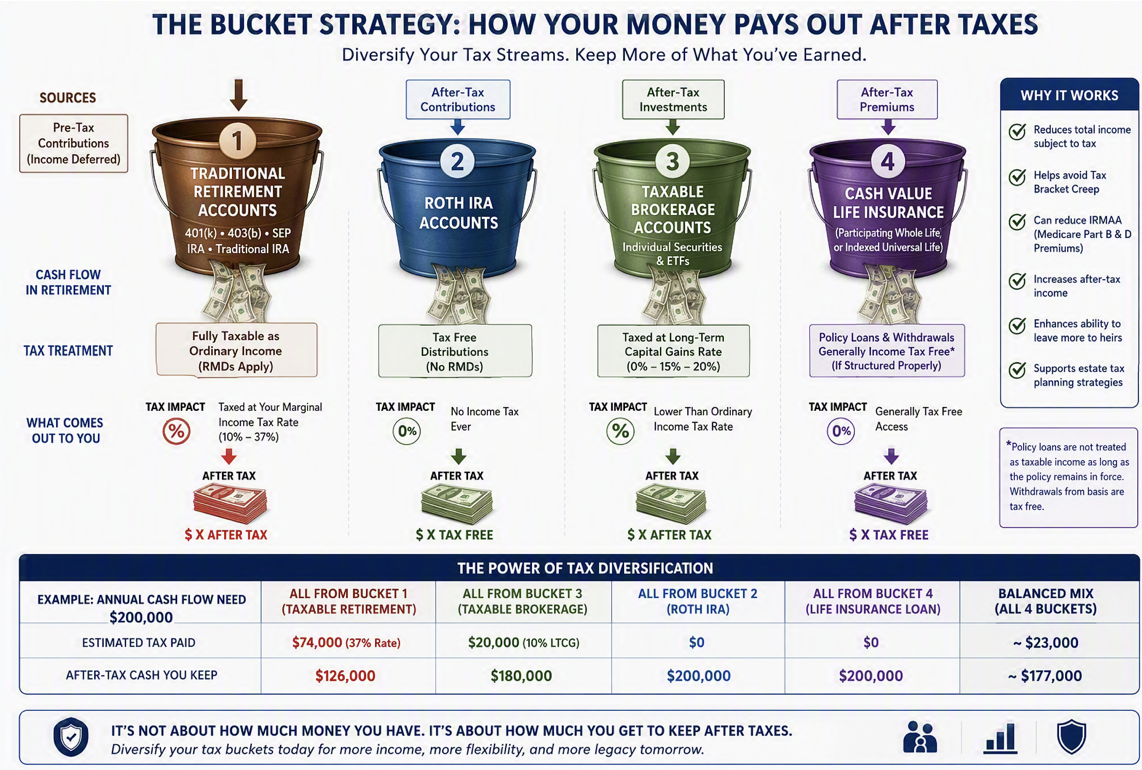
We think clients must also diversify their income tax streams. What people need to realize is that this is as important as the investment allocation of their assets. I often use "buckets" as a means of explanation. Bucket one holds traditional retirement accounts. Bucket two is filled by Roth IRA's (which pour out tax free). Bucket three is brokerage accounts that hold individual securities and ETF's. Finally, bucket four is filled with specific types of insurance policies.
Why this works:
As written above, we cannot help what the income tax brackets are or will be. We also cannot control RMD's. Bucket One is subject to these. Bucket Two is distributing tax free. Bucket Three is subject to capital gain rates, which in the long-term rate status is much lower than the income tax rate. Bucket Four, being a specific type of insurance policy, allows the policy owner to draw from the policy in the form of a loan against the death benefit that pays out tax free.
As I hope you can see, having the assets properly diversified from a tax standpoint can make a massive difference in annual income tax paid, Medicare costs, transfer of generational assets, as well as estate taxes being mitigated by a sound estate planning process.
DISCLAIMER:
Redfish Capital Management, LLC is registered as an investment adviser with the SEC and only transacts business in states where it is properly registered or is excluded or exempted from registration requirements. Registration as an investment adviser does not constitute an endorsement of the firm by the SEC, nor does it indicate that the adviser has attained a particular level of skill or ability.
The content presented is developed from sources believed to be accurate and should not be regarded as a complete analysis of the subjects discussed. All expressions of opinion reflect the judgment of the author and are subject to change. The information in this material is not intended as tax or legal advice. A legal or tax professional should be consulted for specific information regarding your individual situation.
The material presented is for general informational purposes only and does not constitute the rendering of personalized investment advice. Past performance may not be indicative of future results. All investment strategies have the potential for profit or loss. Different types of investments involve varying degrees of risk, and there can be no assurance that any specific investment or strategy will be suitable or profitable for a client's portfolio. Content should not be construed as an offer to buy or sell, or a solicitation of any offer to buy or sell any of the securities mentioned.